Eye on Grace Foundation Gift Brings Hope to Patients with Uveal Melanoma
By: Kaitlin Busch
A Gift Rooted in Hope
A $100,000 gift from the Eye on Grace Foundation to UPMC Hillman Cancer Center is helping advance research for patients facing uveal melanoma, a rare and aggressive eye cancer with limited treatment options.
The gift supports the work of Udai Kammula, MD, director of the Solid Tumor Cell Therapy Program at UPMC Hillman Cancer Center, whose research focuses on tumor-infiltrating lymphocyte (TIL) therapy for solid tumors, including metastatic uveal melanoma. TIL therapy uses a patient’s own immune cells, grown and strengthened in the lab, to help fight cancer.
“For patients with metastatic uveal melanoma, the need for more effective treatments remains urgent. This generous gift from the Eye on Grace Foundation gives us critical support to continue advancing TIL research and translating what we learn in the laboratory into better treatment strategies for patients,” Dr. Kammula said. “Private philanthropy is especially important in rare cancers because it allows promising research to keep moving forward at moments when traditional funding may be limited.”
For Eye on Grace founder Ashley McCrary, the gift is both deeply personal and firmly rooted in the foundation’s mission: helping patients reach care today while supporting research that may create more options for tomorrow.
Ashley’s connection to uveal melanoma began in 2012, when a friend noticed a dark spot on her eye during a beach trip. At 42, Ashley was living in Memphis with her husband, Dave, and their four children when doctors diagnosed her with ocular, or uveal, melanoma. The cancer ultimately led to the removal of her right eye and began a journey that would shape her life — and eventually help change the lives of other patients facing the same rare disease.
For several years, regular scans showed no evidence of disease. Then, in 2020, the cancer returned and spread to her liver. Ashley began traveling from Auburn, Alabama, to Thomas Jefferson Hospital in Philadelphia for treatment. At first, she made the trip monthly. After that treatment stopped working and she qualified for a clinical trial, the trips became weekly. For four and a half years, she flew to Philadelphia on Sundays, received treatment on Mondays, and returned home on Tuesdays — always with someone by her side.
The schedule was exhausting, but Ashley knew she was fortunate. A cancer indemnity plan with Aflac, a benefit of her job in sales at the time, helped cover travel expenses — everything from flights to hotel stays — for her and a caregiver. As she met others facing the same diagnosis, she realized many patients did not have that kind of support, and many could not afford the care they needed.
The clinical trial gave Ashley more time and, for a while, a renewed sense of possibility. She responded well to treatment and became the first patient in the trial to have a partial response, a meaningful milestone in the clinical trial setting. But like many patients living with metastatic uveal melanoma, Ashley’s treatment path has remained uncertain. Over time, the cancer progressed to her lungs and breast, which were treated with radiation. She later began another clinical trial, KIMMTRAK®, and remained on it until last year, when it stopped working. Today, Ashley is once again searching for her next treatment option, holding on to the sense of purpose that has carried her through each step.
The Power of Purpose
After going on disability, Ashley missed the sense of purpose work had given her. She began painting watercolors, pairing them with inspirational quotes and Bible verses, and selling the pieces to help people with ocular melanoma travel for care.
What started as a small act of generosity quickly grew. Ashley and Dave initially thought they might help two or three people a month. Instead, the ocular melanoma community embraced the effort, donors stepped forward, and Eye on Grace Foundation officially launched in 2024 to ease the financial burden of treatment-related travel for patients with uveal melanoma.
“People want to go to a center of excellence for treatment, but they can’t afford to go. With uveal melanoma, there is no cure. So, you’re on a treatment as long as you can be until it stops working. Then you have to hop to another lily pad and do that as long as you can,” Ashley said. “We get to meet people in their most vulnerable state — people who think there’s no hope — and we get to give them the hope that they can get the treatment they need.”
The foundation’s name is deeply personal. Ashley has one eye, and she often says Eye on Grace is a reminder to “keep your eye on grace.” The name also reflects the Christian faith that has sustained her through diagnosis, treatment, recurrence, and uncertainty, as well as one of her favorite Bible verses: 2 Corinthians 12:9, “My grace is sufficient for you, for my power is made perfect in weakness.” For Ashley, that faith remains a source of strength and continues to shape the foundation’s work.
“We believe every person has a right to figure out where they want to go for treatment and be treated,” Ashley said. “They want to be seen, and they want to be heard. There’s a tangible need that we can meet.”
That experience — living from one treatment option to the next while traveling long distances for care — shaped Ashley’s understanding of what patients need most: access, support, and a path forward. It also gave Eye on Grace its purpose: helping patients reach the care and clinical trials that may offer their next best option, while keeping sight of the research needed to make those options possible.
The Power of Removing Barriers
Today, Eye on Grace provides travel grants to patients receiving treatment for ocular melanoma. Eligible patients can receive up to $1,000 per person, per trip, with additional support available for one caregiver. Grants may help cover lodging, flights, gasoline, rideshares, and parking.
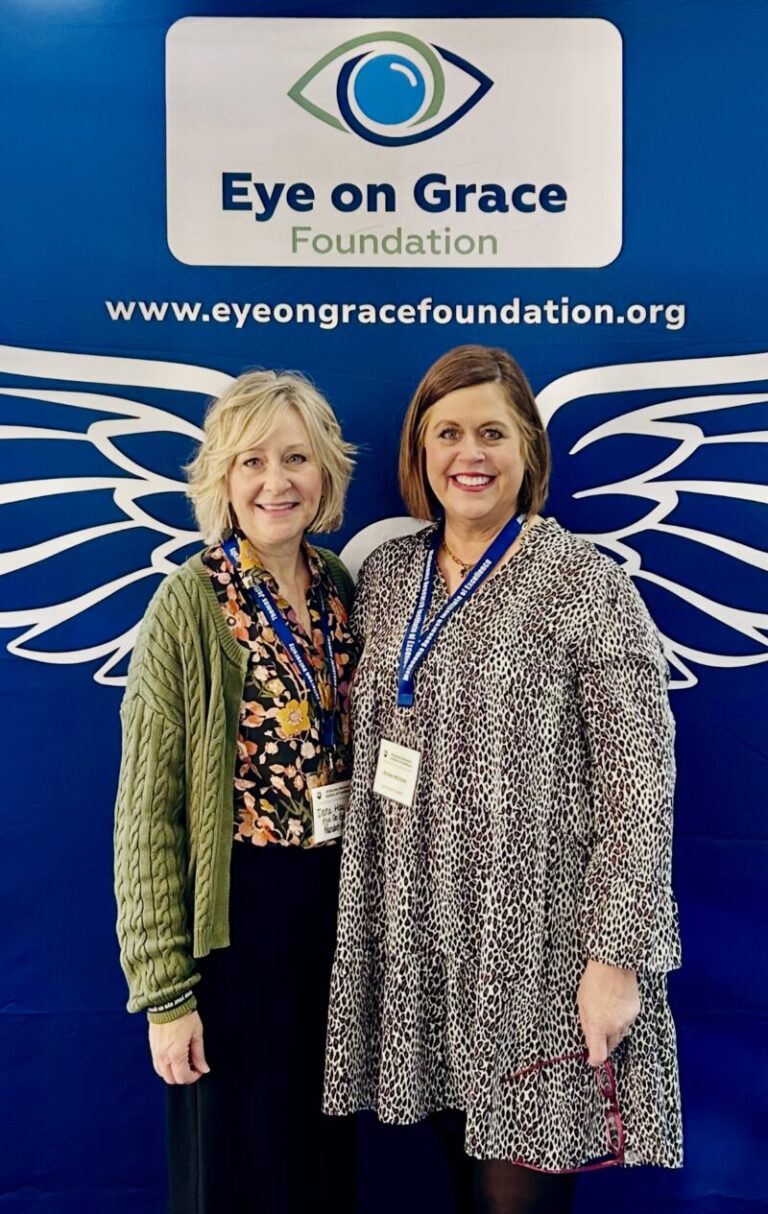
The application process is intentionally simple. Patients provide documentation of their diagnosis and treatment-related travel, but they are not asked to prove financial need. For Ashley and Dana Hay, the foundation’s administrator and a contributing artist, the goal is to remove one more obstacle during an already difficult time.
“We have no stipulations around financial need,” Dana said. “We believe people who have this diagnosis have enough on their plate without another hoop to jump through.”
Many patients learn about Eye on Grace through social media, online support communities, clinicians, patient advocates, and word of mouth. When newly approved patients learn that help is available quickly, often within days, they respond with disbelief.
“Just to hear the incredulity in people’s voices — they can’t believe it’s that simple, that fast, that true,” Dana said. “It is by far the most rewarding thing that we do.”
The Power of Community
From the beginning, Eye on Grace has been a family effort. Dave serves as vice president of the board, Ashley’s daughter serves as secretary, and her children have helped with everything from packaging artwork to mailing eye patch kits for the annual Eye Patch Challenge during Ocular Melanoma Awareness Month in May.
That spirit of shared purpose has grown far beyond Ashley’s home. As of August 2026, Eye on Grace had awarded more than $480,000 in grants for the year, representing more than 1,000 trips for patients and caregivers. Since its inception in May 2024, the foundation has provided $1 million in grants — each one reflecting its central belief that generosity can meet patients at a practical point of need.
The grants do more than offset expenses. They help patients continue treatment or take part in clinical trials without the added weight of significant financial strain, easing the costs of travel, lodging, and caregiver support. Today, the foundation supports 50 patients enrolled in clinical trials, helping them stay connected to promising treatment options when cost might otherwise stand in the way.
“Our primary mission is to help people travel for treatment,” Ashley said. “We don’t tell you where to go. We just give you the money to get there.”
Why Eye on Grace Chose UPMC Hillman
Even as travel grants remain the foundation’s core mission, Ashley knew access to care today was only part of the need. Patients with metastatic uveal melanoma also need more effective treatment options for tomorrow. That belief led Eye on Grace to expand its impact through research support. It ultimately brought Ashley to UPMC Hillman Cancer Center, where philanthropy could help fuel research that may shape future care.
Ashley first learned about UPMC Hillman Cancer Center through patients whose stories inspired her, including Sophie Cantu Stevens, whom Eye on Grace supported as she traveled to Pittsburgh for treatment. Sophie’s experience showed Ashley how a travel grant could remove one barrier between a patient and a promising treatment option — and how research at UPMC Hillman could help expand what is possible for patients in the future.
Later, at a Melanoma Research Alliance conference, Ashley heard Dr. Kammula present his work in TIL therapy and had the chance to speak with him one-on-one. His thoughtful approach strengthened her belief that Eye on Grace could help champion research with the potential to improve outcomes for people with metastatic uveal melanoma.
“It makes me trust him,” Ashley said. “It makes me have hope.”
That belief soon became action. As Eye on Grace was considering directing a portion of its fundraising to research, Ashley received an unexpected call from a woman who had learned about the foundation through a People magazine story about Ashley and Eye on Grace. The donor made a significant gift designated specifically for research through the Wade M. Shavell Trust. Eye on Grace matched the donation, deepening the foundation’s commitment to advancing better treatment options for patients with uveal melanoma.
The donor’s gift helped Eye on Grace double the impact it had originally hoped to make, resulting in the $100,000 donation to support Dr. Kammula’s work at UPMC Hillman Cancer Center. For Ashley, the timing felt providential. As the clinical trial she was on stopped working and she began searching for a new option herself, the gift became both a personal act of faith and a collective investment in research that may help more patients find a way forward.
“I saw it as an answered prayer. We’re praying that continual provision will be there so that miracles can happen,” Ashley said. “I think he is onto something, and I keep saying I think we’re going to see a cure for uveal melanoma in my lifetime.”
The Power of Saying “Yes”
For Ashley, Eye on Grace is more than an organization. It is her family’s faith put into motion, an artist’s creativity turned into care, and a community’s generosity directed toward patients who need options, support, and encouragement.
Ashley knows the road for people with metastatic uveal melanoma is often long and uncertain. Looking ahead, she and Dana hope Eye on Grace will remain sustainable for years to come — continuing to walk alongside patients, helping them reach care wherever it may be found, and supporting research that could change what is possible.
“We always say that we have never had to say no,” Dana said. “That’s what I hope — that we’ll never have to say no.”
Ashley’s story reflects the heart of The Power of Hope: the belief that generosity can help move cancer care forward. Through Eye on Grace Foundation’s $100,000 gift to UPMC Hillman Cancer Center, that generosity is advancing research that may lead to better options for patients with uveal melanoma, while continuing the foundation’s commitment to removing barriers to care. For patients facing a rare and aggressive cancer, the gift brings access and discovery together — helping more people reach treatment today while supporting progress that could change what is possible tomorrow.
To learn more about Eye on Grace Foundation and its mission, visit www.eyeongracefoundation.org.